



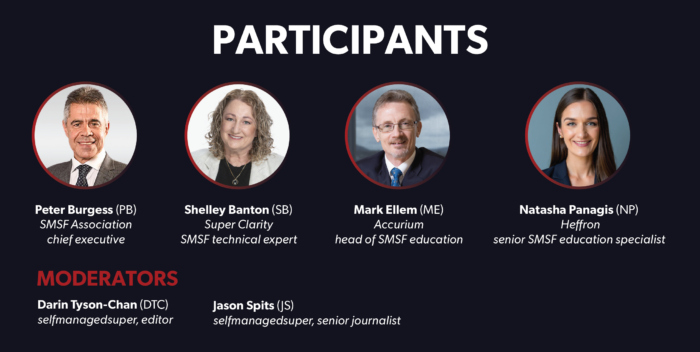
Recent plans the government outlined to protect consumers with regard to their superannuation were key topics of discussion at the selfmanagedsuper 2026 SMSF roundtable, with plans for mandatory education of trustees at time of fund establishment raising questions and concerns.
JS: Among the range of consumer protection measures proposed by the government is the mandatory education of prospective SMSF trustees before they establish their fund. Is there any indication of what this might look like and how it will work?
PB: There was some information in the government’s dashboard impact analysis which talked about mandatory education. We have got no qualms with uplifting trustee competency standards and we are doing some work in that space to try and raise the level of competencies trustees have got. The analysis indicated the requirement could involve having to undergo a three-hour course. The ATO already has a course encompassing three different modules, which in total is around three hours long. They seem to have the idea in mind it will be those modules trustees will have to complete under this measure. Looking at some of the language Financial Services Minister Daniel Mulino used, and some of the commentary we can see in this analysis, it’s not clear as to whether that’s intended to be the only option. We hope it’s not and what we will be saying to government is for it to keep an open mind as to how we uplift trustee competencies. We’re nervous about a one-size-fits-all education course for all new trustees. As an example, the 35 to 45-year-old group is the fastest-growing area for SMSFs right now and it’s pointless in our view teaching a 35-year-old about an account-based pension and exempt current pension income. Those things are not relevant to them at this point, so we would prefer to see a more tailored approach to education which addresses what trustees need to know at their stage as a superannuant.
SB: What’s the barometer for success? Is it actually going to make better trustees at the end of the day? What about having periodic updates and refreshment in terms of that trustee education? Even more importantly, what’s going to happen when a trustee fails? Is there a three-strikes-and-you’re-out policy and then you can never have an SMSF? These are the sorts of questions we don’t really understand. This is a discussion that needs to be had so we understand this isn’t going to be another barrier for people to get into self-managed super.
NP: It’s hard to argue against this reform because we all know trustee capability is going to be fundamental to the success of an SMSF. The debate isn’t about whether education is necessary, but how to deliver it effectively. Poor outcomes will usually lead to poor understanding of the super law and education will be part of that solution, but it can’t be this box-ticking exercise that allows everyone to say they have completed the trustee module and we have solved the problem. Industry-led education is going to be much more effective than an ATO compliance course because we come at it from a more practical viewpoint as to what a trustee will need to know in certain life stages. Trustees will need to have variety as to where they get this education from. We would love to be involved in that process given the opportunity.
JS: Will a mandatory education requirement be more effective as a competency measure than the current trustee declaration?
ME: In relation to the ATO courses, I think they are quite good, but my concern is how can this be anything more than a tick-a-box exercise? The rules, as we know, change so if you complete some education at one point in time and you think ‘I know it all’, well, no you don’t. We are all subject to continuing professional development and if you bring trustees into the system, why wouldn’t they be subject to continuing education? Being educated and knowing the rules is common sense. You should understand the rules, but what is the pass mark going to be? Is there going to be an assessment? Do you do the test alone? I am all for education, absolutely. How it’s delivered, that’s going to be difficult. If it is by private enterprises, I would expect them to commercialise it and gain income, but is that an additional barrier to entry? Trustees will have to do the education, but who is going to provide a free three-hour course? Also, if you are doing mandatory education and it’s just at one point in time, I don’t think it’s going to achieve the goal because do we think the super rules are going to be exactly the same in five years’ time? I’m a bit sceptical about the benefits. I’m 100 per cent behind the intention, but worry it won’t achieve its intended goals.
NP: It also depends on who’s setting up these funds. If you have an adviser and they have recommended the set-up of an SMSF, do you argue the trustee is in an advice relationship and might not need that education versus a self- directed trustee? Is it going to differ and will the education change depending on who the SMSF trustee is?
JS: Is there a possibility this education requirement will be applied in a broader context and not just at the time of fund set-up?
SB: Perhaps, because education is also about getting trustees switched on to their roles and responsibilities. The trustees and members are one and the same so there’s a vested interest to make sure their retirement savings are going to be there when they retire and they are meeting the sole purpose test. The rules and regulations will be the compliance aspect, but what about education for what can go wrong? Are we going to be broadening that and talking about other areas, such as scams and frauds, being alert, making sure they are not being taken advantage of, the person they are talking to on the phone is a real person, and all of those sorts of things? What’s the scope of the education to be put into place and maybe that’s where bringing all of those parts together becomes really important? Not only just from making sure the consumer harm is being minimised down to zero, but also making people interested in their money rather than just parking it with an adviser and letting them deal with it. There has to be some buy-in as well. If we look at the First Guardian and Shield master fund collapses, would any of this trustee education have mitigated any of that? We don’t know as we don’t have enough detail to be able to comment on that. An holistic approach to making sure trustees are looking after their super fund for the right reasons, where they have some buy-in as well, and bringing all of those parts together might be something which changes the mindset of people looking to get into an SMSF, rather than just ticking a box.
DTC: When announcing this proposed measure, Financial Services Minister Daniel Mulino praised industry groups for already lifting the level of education for trustees. Could this be seen as an indication any education provided will not just be the realm of the ATO?
PB: Based on the language we have seen, I think they haven’t closed the door on other providers for this mandatory education they are talking about. Mulino’s reference was to the SMSF Association and the work we’re doing to uplift trustee standards, which was based on a conversation we had with his office the day before. We had a number of meetings leading up to the announcement and were advised the day before they were looking at trustee education, and so we had a conversation around our work in the area of a voluntary code of conduct for service providers, which will be underpinned by standards. One of those standards will be around establishing an SMSF and that would have an education focus attached to it. That’s why he was keen to recognise the fact there is already work underway in that space, but he did indicate a willingness to work with us and others in the industry who are actively trying to uplift these competency standards. We just don’t know what that looks like, but I’m hopeful the door is open for other providers of this mandatory education as it is not our preference a course facilitated by the ATO is the only option that people will have.
Click here to read part 1 of the roundtable discussion

Darin Tyson-Chan
Editor
Darin is the founder and publisher of Benchmark Media, an independent publishing house whose mastheads include financialobserver, selfmanagedsuper and smstrusteenews. He has been covering the financial services space for over a decade and in this time he has worked for a variety of trade publications. Darin has also written for the Money section published in The Sydney Morning Herald and The Age.
Articles by Darin
Jason Spits
SENIOR JOURNALIST
Jason is a senior journalist with Benchmark Media and writes for the selfmanagedsuper website and magazine and smstrusteenews website. He has covered financial services since 1999 and has written about life insurance, superannuation, investment management and financial advice, in both a freelance and in-house capacity, and also did a brief stint as a media manager for an industry association. He has been the editor of trade titles Money Management and Financial Standard, and was most recently senior journalist with life insurance title Riskinfo.
Articles by Jason